

The Power of Collaborative Divorce Support
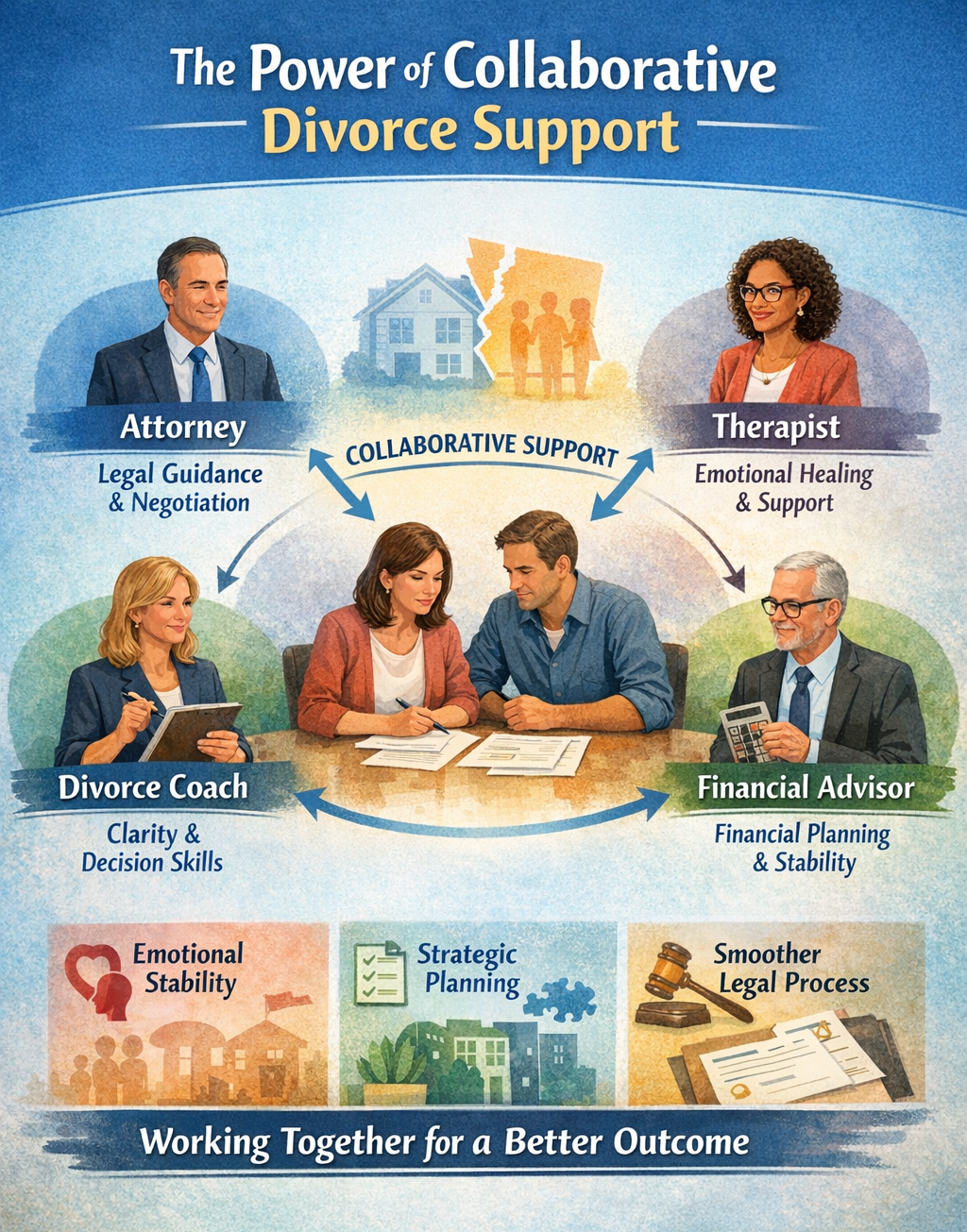
Divorce is not a single moment or decision. It is a layered, evolving process that unfolds over time, affecting emotional well-being, financial stability, parenting dynamics, personal identity, and the ability to make sound decisions under pressure. While the legal system is essential for addressing rights, obligations, and outcomes, it is not designed to support the emotional and cognitive strain clients endure as they navigate those decisions.
In my practice, I work with clients who navigate this complexity every day. What consistently makes the greatest difference is a collaborative support model—one in which divorce coaching works alongside legal representation and, when appropriate, therapeutic support. When each professional contributes their expertise within clearly defined boundaries, clients experience a process that feels more intentional, less reactive, and ultimately more sustainable.
Creating Continuity Through Collaboration
One of the most challenging aspects of divorce is the fragmentation clients often feel. Legal discussions, emotional reactions, parenting concerns, and financial fears can feel disconnected and overwhelming.
A collaborative approach creates continuity.
Attorneys focus on legal strategy, negotiation, and compliance. My work as a divorce coach centers on helping clients stay emotionally regulated, organized, and clear-headed so they can meaningfully engage with the legal process rather than feel consumed by it.
Within coaching sessions, clients are supported in:
Clarifying priorities related to children, finances, housing, and long-term goals
Separating emotional reactions from strategic decisions
Preparing thoughtfully for legal meetings, mediation, and negotiations
Developing communication strategies that reduce escalation and misinterpretation
Breaking complex decisions into manageable, sequential steps
Because clients are supported in how they think and decide, legal advice becomes easier to absorb, evaluate, and implement. This continuity reduces decision fatigue and allows clients to move through divorce with greater steadiness rather than feeling pulled in multiple directions.
Supporting a More Effective Legal Process
Divorce law is practiced in a highly emotional environment. Even the most capable clients can struggle to process information, retain guidance, or communicate clearly when overwhelmed or emotionally flooded.
In my work with clients represented by counsel, divorce coaching often serves as the stabilizing layer that improves the legal process. Clients tend to arrive at legal meetings better prepared, more focused, and with a clearer understanding of what needs to be decided. They are better equipped to ask targeted questions, evaluate trade-offs, and follow through on next steps.
This support often leads to:
Fewer crisis-driven communications
Reduced emotional escalation between legal milestones
More efficient use of legal meeting time
Smoother negotiations and fewer reactive reversals
From an attorney’s perspective, this collaboration keeps legal work strategic rather than reactive. From a client’s perspective, it fosters a sense of agency and clarity in a process that often feels disempowering.
Working in Alignment with Therapy and Psychological Support
Many clients I work with are also in therapy or receiving psychological support, and this combination can be especially effective when roles are clearly defined.
Therapy focuses on healing, emotional processing, trauma, and mental health. Divorce coaching is forward-focused and practical, centered on navigating decisions, responsibilities, and communication as they arise in real time.
In practice, coaching helps clients translate insight into action. Clients work to apply coping strategies, set boundaries, organize information, and maintain structure during a destabilizing period. When both supports are in place, therapy sessions are often more productive because immediate logistical stressors are handled elsewhere. Coaching, in turn, provides continuity between sessions and supports follow-through.
Rather than overlapping, these services reinforce one another—supporting both emotional healing and functional decision-making.
The Value of Professional Divorce Coaching
Divorce coaching is a professional service and a meaningful investment. Its value lies not only in support but also in prevention.
By helping clients slow down, regulate emotions, and organize complex information, coaching reduces the likelihood of impulsive decisions that can lead to prolonged conflict, increased legal costs, or long-term regret. Clients often report that coaching helps them feel more grounded, more confident, and better able to tolerate uncertainty while decisions unfold.
Over time, this clarity often:
Improves decision quality under pressure
Reduces conflict that escalates legal fees
Supports healthier co-parenting dynamics
Creates a stronger foundation for post-divorce stability
The return on investment is not measured solely in outcomes, but in reduced stress, improved confidence, and a smoother transition into the next phase of life.
An Integrated Model Within My Practice
In my practice, divorce coaching is designed to work alongside legal and psychological services—not in competition with them. I do not provide legal advice or clinical therapy. Instead, I help clients engage more effectively with the professionals already on their team.
This includes preparing for legal discussions, organizing thoughts and documentation, managing emotional responses, and staying anchored in long-term priorities. Each professional remains firmly in their lane, creating consistency rather than confusion.
Clients often describe this integrated model as grounding. Rather than receiving fragmented guidance, they experience a cohesive support structure in which each service reinforces the others in an ethical and aligned manner.
Accessible Support That Fits Real Life
Divorce rarely unfolds in neat or predictable ways, and support needs to be accessible. To maintain continuity, I offer coaching sessions via secure virtual platforms such as Zoom and Google Meet.
Virtual sessions allow clients to remain supported regardless of location, work demands, or shifting schedules. This flexibility reduces logistical strain and makes it easier to maintain consistent support during an already demanding process.
A More Supported Way Forward
Divorce is not simply about ending a marriage—it is about shaping what comes next. The decisions made during this period often have long-term emotional, financial, and relational consequences.
When legal strategy is grounded in emotional clarity, structure, and thoughtful decision-making, clients are better positioned to move forward with confidence rather than urgency. A collaborative approach that includes both a divorce coach and an attorney provides that foundation.
It allows clients to navigate divorce with intention, stability, and a clearer vision for the future—supported not only legally but also as whole people navigating a significant life transition.